UUID Generator
A fresh UUID is generated the moment the page loads. Choose the version, the number and the format; GUID is Microsoft's name for the same identifier.
Generated in your browser from its cryptographic random source. Nothing is sent to a server. Sources: RFC 9562 Updated
Check a UUID or GUID
Paste any UUID to see whether it is well formed, which version and variant it is, and the timestamp stored in a version 1 or version 7 value. Braces, uppercase letters, a urn:uuid: prefix and missing hyphens are accepted.
UUID format: how the 128 bits are laid out
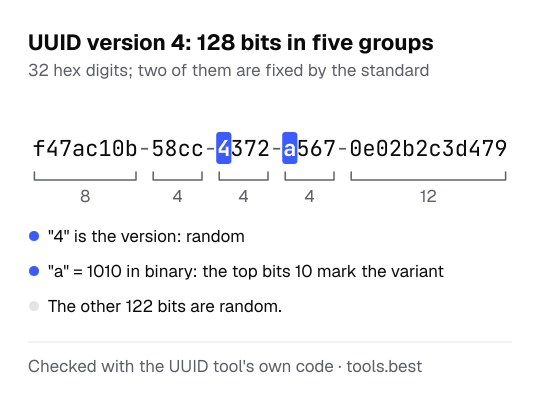
A UUID is 128 bits, written as 32 hexadecimal digits in groups of 8, 4, 4, 4 and 12. Each digit is half a byte, in the same base-16 notation the text to hex converter uses:
xxxxxxxx-xxxx-Vxxx-Nxxx-xxxxxxxxxxxx
V is the version. N is 8, 9, a or b: its top two bits are 1 and 0, which mark the variant of the standard. The other 122 bits depend on the version.
| Version | What the bits contain | Example |
|---|---|---|
| 4 | 122 random bits. | f47ac10b-58cc-4372-a567-0e02b2c3d479 |
| 7 | 48 bits of Unix time in milliseconds, then 74 random bits. | 017f22e2-79b0-7cc3-98c4-dc0c0c07398f |
| Nil | All 128 bits zero. Stands for "no UUID". | 00000000-0000-0000-0000-000000000000 |
The version 7 example is the one from RFC 9562. Its first twelve digits, 017f22e279b0, are the timestamp: 2022-02-22T19:22:22.000Z.
How to build a version 4 UUID from 16 random bytes
- The browser supplies 16 random bytes, for example
f4 7a c1 0b 58 cc c3 72 25 67 0e 02 b2 c3 d4 79. - The high four bits of byte 7 are replaced by the version, 0100:
c3becomes43. - The high two bits of byte 9 are replaced by the variant, 10:
25becomesa5. - The bytes are written in hex with hyphens after bytes 4, 6, 8 and 10:
f47ac10b-58cc-4372-a567-0e02b2c3d479.
UUID formats: hyphens, braces and uppercase
| Format | Looks like | Where it is used |
|---|---|---|
| Lowercase with hyphens | f47ac10b-58cc-4372-a567-0e02b2c3d479 | The form the standard recommends for output. |
| Uppercase | F47AC10B-58CC-4372-A567-0E02B2C3D479 | Common in Windows and .NET output. |
| Braces | {F47AC10B-58CC-4372-A567-0E02B2C3D479} | The Windows registry format for GUIDs. |
| No hyphens | f47ac10b58cc4372a5670e02b2c3d479 | Compact 32-character keys and file names. |
All four are the same value. Changing the format options rewrites the UUIDs already shown; it does not generate new ones.
Versions 3 and 5, which this page reads but does not make, are built from an MD5 or SHA-1 hash of a name instead of random bytes; the hash generator shows those digests for any text. The other generators on this site make QR codes, schema markup and ASCII art.
UUID Generator: FAQ
What is a UUID and why is it used?
What is the difference between a UUID and a GUID?
Can two generated UUIDs be the same?
Should I use version 4 or version 7?
Are these UUIDs safe to use as secrets?
crypto.getRandomValues, the browser's cryptographic random generator, so version 4 values are unpredictable. A UUID is still designed as an identifier, not as a password or access token: version 7 exposes its creation time, and identifiers tend to end up in logs and URLs.Why is there always a 4 in the same place?
Can you decode a UUID?
Why is no UUID written into the page itself?
Sources
- RFC 9562: Universally Unique IDentifiers (UUIDs) — May 2024; replaces RFC 4122. Sections 5.4 (version 4) and 5.7 (version 7)
- W3C Web Cryptography API: getRandomValues