MD5 Hash Generator
Type or paste text and read its MD5, SHA-1 and SHA-256 hash, computed from the UTF-8 bytes of exactly what is in the box.
Runs in your browser. Nothing you enter is sent to a server. Sources: RFC 1321, FIPS 180-4 Updated
MD5 (32 hex characters)
d41d8cd98f00b204e9800998ecf8427e
SHA-1 (40 hex characters)
da39a3ee5e6b4b0d3255bfef95601890afd80709
SHA-256 (64 hex characters)
e3b0c44298fc1c149afbf4c8996fb92427ae41e4649b934ca495991b7852b855
How the MD5 hash generator computes a hash
- The text in the box is turned into bytes as UTF-8, the same bytes the text to hex converter shows. A plain English letter or digit is one byte,
éis two,€is three and an emoji is four or more. A line break in the box is one byte (LF). - Those bytes go through the algorithm: MD5 as written in RFC 1321, SHA-1 and SHA-256 as written in NIST FIPS 180-4.
- The result is shown in hexadecimal, two characters for each byte of the hash.
Nothing is added to your text. There is no line break at the end unless you type one, and there is no salt or key. The same bytes always give the same hash, and the hash has the same length whether you enter one letter or a whole page.
A hash is not an encoding. Base64 or hex can be turned back into the text; a hash cannot. If you need a random identifier rather than a fingerprint of a text, use the UUID generator.
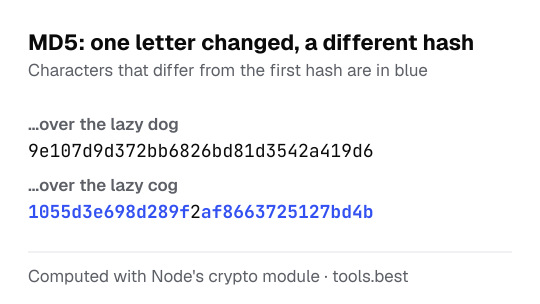
MD5 example: one letter changes the whole hash
Press "Load sample text". The box now holds The quick brown fox jumps over the lazy dog, which is 43 characters and 43 bytes. The results are:
- MD5:
9e107d9d372bb6826bd81d3542a419d6 - SHA-1:
2fd4e1c67a2d28fced849ee1bb76e7391b93eb12 - SHA-256:
d7a8fbb307d7809469ca9abcb0082e4f8d5651e46d3cdb762d02d0bf37c9e592
Change the last word from dog to cog and the MD5 becomes 1055d3e698d289f2af8663725127bd4b. One changed letter gives a completely different hash, which is what makes a hash useful for spotting changes.
MD5 test values from RFC 1321
| Text | Bytes | MD5 |
|---|---|---|
| (empty) | 0 | d41d8cd98f00b204e9800998ecf8427e |
a | 1 | 0cc175b9c0f1b6a831c399e269772661 |
abc | 3 | 900150983cd24fb0d6963f7d28e17f72 |
message digest | 14 | f96b697d7cb7938d525a2f31aaf161d0 |
These four pairs are printed in the test suite of RFC 1321, appendix A.5. For abc the SHA-1 is a9993e364706816aba3e25717850c26c9cd0d89d and the SHA-256 is ba7816bf8f01cfea414140de5dae2223b00361a396177a9cb410ff61f20015ad. Those two, and the sample text results above, match what OpenSSL returns for the same bytes.
MD5, SHA-1 and SHA-256 compared
| Algorithm | Hash length | Defined in | Use it for |
|---|---|---|---|
| MD5 | 128 bits, 32 hex characters | RFC 1321 | Checking for accidental changes, and older systems that expect it. Not for signatures or anything an attacker could profit from forging: RFC 6151 reports that two inputs with the same MD5 can be found in about a minute on a notebook computer. |
| SHA-1 | 160 bits, 40 hex characters | FIPS 180-4 | Older systems that expect it. NIST retired SHA-1 in December 2022, advises moving to SHA-2 or SHA-3, and will stop using it by 31 December 2030. |
| SHA-256 | 256 bits, 64 hex characters | FIPS 180-4 | New work. It belongs to the SHA-2 family that NIST names as a replacement for SHA-1. |
None of the three is suitable on its own for storing passwords. They are fast by design, so guesses can be tested quickly. See the question on passwords below.
MD5 Hash Generator: FAQ
Can an MD5 hash be decrypted?
Why is my hash different from the one another tool gives?
echo abc | md5sum hashes four bytes, because echo adds a line break), Windows line endings, a space you cannot see, or a different text encoding such as UTF-16. Compare the byte count under the box with the size of your input.Is MD5 still safe to use?
Can I hash a file here?
md5sum, sha1sum or sha256sum on Linux, md5 or shasum -a 256 on macOS, and Get-FileHash in PowerShell on Windows.Should I store passwords as MD5 or SHA-256?
Sources
- RFC 1321: The MD5 Message-Digest Algorithm — the algorithm and the test values in appendix A.5 (checked October 12, 2026)
- RFC 6151: Updated Security Considerations for the MD5 Message-Digest and the HMAC-MD5 Algorithms — why MD5 must not be used where collision resistance matters (checked October 12, 2026)
- NIST FIPS 180-4: Secure Hash Standard — defines SHA-1 and SHA-256 (checked October 12, 2026)
- NIST: NIST Retires SHA-1 Cryptographic Algorithm (15 December 2022) (checked October 12, 2026)
- OWASP Password Storage Cheat Sheet (checked October 12, 2026)
- Microsoft Learn: Get-FileHash (checked October 12, 2026)