Generators
Generators for identifiers, QR codes and markup, made in your browser and ready to copy.
A generator produces something new from a few settings instead of converting an input. The four here cover identifiers, scannable codes, structured data and decoration.
The UUID generator creates two kinds of UUID defined in RFC 9562, random version 4 and time-ordered version 7, one at a time or up to a thousand, in the formats different systems expect, including the uppercase-in-braces form that Windows calls a GUID. The random bytes come from your browser's cryptographic generator. The same page checks an existing UUID and reads the timestamp out of it.
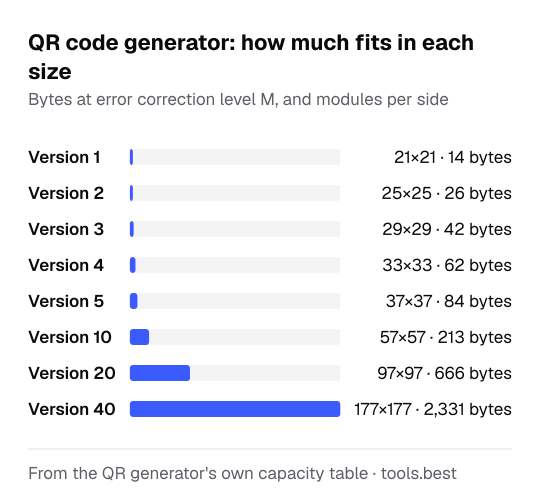
The QR code generator draws a code for a link or any text and saves it as PNG or SVG. The codes are static: the content is in the pattern itself, so there is no redirect service that could expire, count scans or go offline. How much fits depends on the QR code version, the size of the grid.
The encoder was verified by decoding codes of every size and error correction level.
The schema markup generator fills in JSON-LD for common schema.org types so search engines can read the facts on a page, and the ASCII art generator turns short text into large letters built from characters.
Looking for random numbers, names, passwords, dice or wheels? Those belong to our sister site RandomVal, which covers randomizers and nothing else.
Everything on this page is generated on your device. What you type into a generator, such as the URL for a QR code or the business details for schema markup, is not sent to a server.
All generators
Sources
- RFC 9562: Universally Unique IDentifiers (UUIDs) (checked October 16, 2026)
- DENSO WAVE: Information capacity and versions of QR Code (checked October 16, 2026)