Synonym Generator
Enter an English word and get up to 100 synonyms for it, looked up live in the Datamuse API.
The word you look up is sent to the Datamuse API. Nothing else leaves your browser. Sources: Datamuse API Updated
When you press "Find synonyms", the word you typed is sent to the Datamuse API at api.datamuse.com, a third-party service. Nothing is sent before you press the button or the Enter key, and nothing else you type on this site is sent.
How the synonym generator looks up a word
- You type a word and press "Find synonyms". The tool makes it lowercase and checks that it contains only letters, spaces, hyphens and apostrophes.
- Your browser sends one request to
https://api.datamuse.com/wordswith two values:rel_syn, set to your word, andmax=100. - Datamuse answers with the words it holds as synonyms. Its documentation defines this relation as words that belong to the same WordNet synset, a group of words that share one meaning.
- The tool lists the words in the order Datamuse sent them. "Show at most" only cuts the list on your screen. Changing it does not send a new request.
Datamuse also returns a number called a score with each word. Its documentation says this number only serves to order the results and has no meaning of its own, so this page does not show it.
Synonyms for happy: an example lookup
Looking up happy on 12 October 2026 returned 26 words. The first twelve were: halcyon, content, bright, felicitous, riant, expansive, elysian, joyful, pleased, euphoric, joyous, prosperous.
The example shows both the use and the limit of the list. "Joyful" and "pleased" are everyday replacements. "Halcyon", "riant" and "elysian" are rare or literary, and "prosperous" or "expansive" fit only in some contexts.
The list is a set of candidates. Its order does not tell you how common a word is or how close it is in meaning. Datamuse can change its data, so you may see a different list.
To keep a phrase alliterative, pick a synonym that starts with the same letter, or start from the word lists of the alliteration generator. For words made from a fixed set of letters rather than a meaning, use the word generator with letters, which runs without any outside service.
What is sent to Datamuse
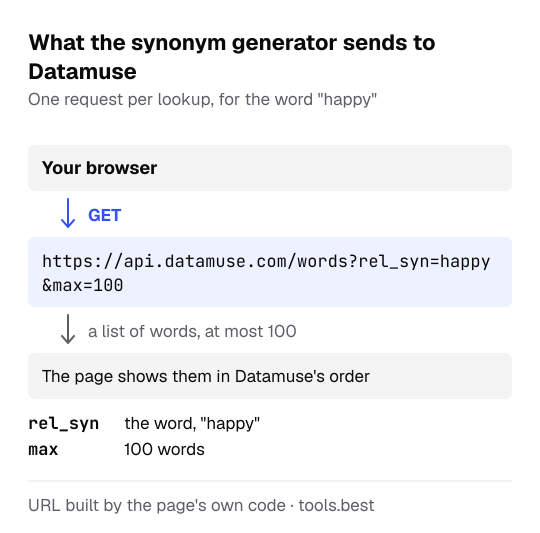
The request contains the word you looked up. As with any request a browser makes, the receiving server also sees your IP address and basic browser details, and the browser may tell it which site the request came from. This site does not add anything else: no account, no identifier and no other text from the page.
According to Datamuse's documentation, the query log on its servers is temporary and is deleted at the end of the day after a request, and the only data kept longer is a count of requests by broad type. That is Datamuse's own statement; this site cannot check it.
Limits of the synonym list
- English only. The lookup uses Datamuse's default vocabulary, which its documentation describes as 550,000 English words and multiword expressions.
- Single words. Spaces are allowed, but phrases usually return nothing. When this page was checked, "ice cream" and "give up" both came back empty.
- All senses mixed. The list does not tell you which meaning of your word a synonym belongs to.
- At most 100 words. The tool asks for 100. If exactly 100 come back, there may be more that are not shown.
- Needs a connection. If Datamuse is unreachable or answers with an error, the tool says so and shows no words.
This is the only tool among the word tools that contacts another service; the privacy page lists every such request on the site.
Synonym Generator: FAQ
Where do the synonyms come from?
Why do some results not fit the meaning I had in mind?
Why did I get no results?
Is the word I look up stored?
Does it work offline?
Sources
- Datamuse API documentation — the rel_syn relation, the max parameter, the meaning of the score, the privacy statement and the data sources (checked October 12, 2026)