Alliteration Generator
This alliteration generator turns a word or a single letter into five phrases whose words all start with that letter. Under them it lists every word it has for the letter.
Runs in your browser. Nothing you enter is sent to a server. Sources: Poetry Foundation, Cambridge Dictionary Updated
Press "Generate phrases".
How the alliteration generator builds phrases
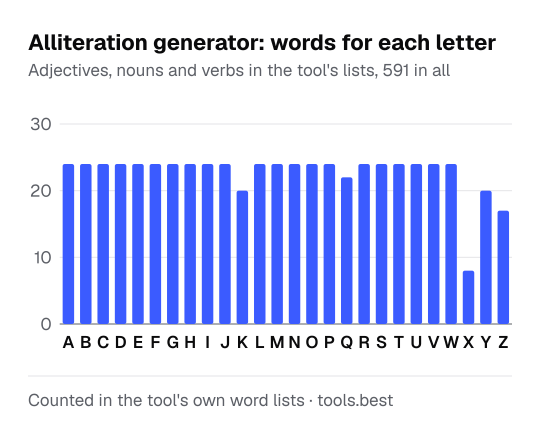
The tool does not write sentences. It holds a fixed list of adjectives, plural nouns and verbs for each letter of the alphabet, 591 words in all. When you press "Generate phrases" it takes the first letter of your word and builds five phrases, each in the same order:
- your word, unless you entered a single letter,
- two or three adjectives picked at random,
- one plural noun,
- one verb.
Words are not repeated inside a phrase, and if your word is itself in the list it is not picked a second time. The picks are random, so pressing the button again gives new phrases. Under the phrases the tool shows every word it has for that letter, which is often more useful than the phrases: pick the ones that fit and write your own line.
The tool does not know whether your word is a noun, a verb or an adjective. A phrase reads best when your word can stand in front of the adjectives, as an adjective or a name can. Treat the output as raw material.
To find a stronger word for one slot, look it up in the synonym generator, and check that the synonym still starts with your letter. To try every order of the words you picked, paste them into the word combination generator. If the phrase becomes a headline, Capitalize My Title sets its capitals by APA, AP, Chicago or MLA rules.
Alliteration examples for the letter B
Enter bright. The first letter is B, so the tool draws on eleven adjectives (bold, brave, beautiful, brilliant, bubbly, bustling, bouncing, blazing, blissful, bountiful, benevolent; "bright" itself is left out), six nouns (butterflies, balloons, beaches, bakers, bears, boats) and six verbs (bounce, build, bring, bloom, blink, bake).
One possible result is "Bright bold blissful bears bounce", another "Bright brave bubbly bustling boats bloom". Your five phrases will differ, because they are drawn at random.
Enter only b and the phrases start with an adjective instead, for example "Bold blissful bears bounce".
Alliteration is about sounds, not letters
Alliteration is a matter of sound, and spelling is only a rough guide to it. To keep the phrases alliterative, the word lists follow these rules:
| Letter | Sound used in the list | Left out on purpose |
|---|---|---|
| C | Hard c, as in "cat" | Soft c ("city") and ch ("cheerful") |
| G | Hard g, as in "garden" | Soft g ("gentle", "giant") |
| H | Sounded h, as in "happy" | Silent h ("honest", "hour") |
| K | Sounded k, as in "kind" | Silent k ("knee", "know") |
| P | Plain p, as in "proud" | ph ("phone") and silent p ("psalm") |
| S | Plain s, as in "sing" | sh ("shine") |
| T | Plain t, as in "tiger" | th ("thankful") |
| W | Sounded w, as in "wave" | Silent w ("write") and wh said as h ("whole") |
| X | The z sound of "xylophone" | "X-ray", where the letter is said as its name |
| A, E, I, O, U | Mixed | Nothing. Vowel letters stand for several sounds ("eager", "elegant"), so these phrases repeat a letter more than a sound. |
The tool cannot hear the word you type. It gives a short warning when your word starts with ch, sh, th, ph, kn, gn, wr, ps or pn, or with a c or g followed by e, i or y, because in those cases the first sound usually differs from the first letter. It does not catch every case: "hour" and "one" pass without a warning.
Questions about alliteration
What is alliteration?
Is it alliteration when the letters match but the sounds do not?
Do the words have to be right next to each other?
Where do the words come from?
Why are there so few words for X?
Sources
- Poetry Foundation: Glossary of Poetic Terms, Alliteration (checked October 12, 2026)
- Cambridge Dictionary: alliteration (checked October 12, 2026)