Card Type Checker (BIN Lookup)
This card type checker names the card network from the first digits of a card, six at most, using the prefix ranges below.
Runs in your browser. The digits are not sent to a server. Sources: IIN ranges table, ISO/IEC 7812 Updated
Card network
Visa
Matches the prefix range Visa 4.
How the card type checker reads a BIN
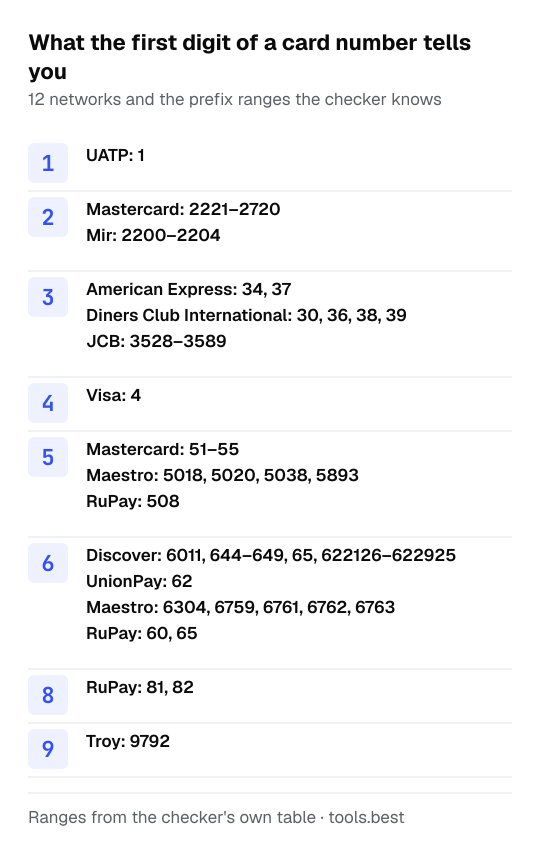
Every card network has been assigned ranges of leading digits. The checker compares the digits you type with the table below and reports the network whose range they fall into. If two ranges match, the longer, more specific prefix wins; if two networks share a prefix of the same length, both are shown.
That is all it does. It does not look at more than six digits, it does not calculate or test a check digit, and it has no data about individual banks or accounts.
Reading a prefix is a common way to tell what kind of thing follows. The Base64 to image converter recognizes a file format from its first bytes in the same way, and an IP address lookup names a provider from the address range a number falls into.
Card number prefixes: BIN ranges by network
| Network | Card numbers start with |
|---|---|
| Visa | 4 |
| Mastercard | 51–55, 2221–2720 |
| American Express | 34, 37 |
| Discover | 6011, 644–649, 65, 622126–622925 |
| Diners Club International | 30, 36, 38, 39 |
| JCB | 3528–3589 |
| UnionPay | 62 |
| Maestro | 5018, 5020, 5038, 5893, 6304, 6759, 6761, 6762, 6763 |
| RuPay | 60, 65, 81, 82, 508 |
| Mir | 2200–2204 |
| Troy | 9792 |
| UATP | 1 |
Ranges as listed in the IIN table cited under Sources, checked on October 12, 2026. Networks change their ranges from time to time, and smaller national schemes are not all included, so "No match" does not mean a card is fake.
BIN lookup examples
424242starts with 4. Every number that starts with 4 is in Visa's range: Visa.551234: the first two digits, 55, are in the range 51–55: Mastercard.222100: the first four digits, 2221, are the start of the range 2221–2720: Mastercard.601100matches RuPay's two-digit prefix 60 and Discover's four-digit prefix 6011. The longer prefix wins: Discover.650000matches the prefix 65, which the table lists for two networks: Discover or RuPay.
Why this page is called Card Type Checker
This address used to carry a tool called "Credit Card Converter". The name was misleading: it never converted anything. It has always identified the card network from the first six digits, and it is now named for what it does.
It sits with the other single-purpose everyday tools, such as the Roman numeral and color converters.
Card Type Checker (BIN Lookup): FAQ
What is a BIN or IIN?
What do the first digits of a card number mean?
Does this tell me which bank issued the card?
Can it tell me whether a card number is valid?
Why does it show two networks for the same digits?
Is it safe to type the first six digits of my card?
Sources
- Wikipedia: Payment card number, table "Issuer identification number (IIN)" — the prefix ranges used by this tool; only networks listed as active (checked October 12, 2026)
- ISO/IEC 7812-1: Identification cards, identification of issuers, part 1: numbering system — the standard that defines card numbers and the IIN